
Building speed starts with learning to stay in control
Bass Player's Weekly | Issue 003

Have you ever learned a bass line slowly, felt pleased with your progress, then tried playing along with the recording? Suddenly, the notes seem closer together, your fingers hurry, and what felt comfortable becomes a struggle.
Here's the thing: playing faster isn't simply about moving your fingers more quickly. It's about maintaining control as the tempo increases.
Last week, we explored different ways to learn a bass line. Now, let's look at how to play it clearly and steadily at faster tempos.
Speed Isn't Everything
Some songs call for quick, busy bass lines; others need just a few carefully placed notes.
There have been times during my recording career when I've had the freedom to create my own bass part, only to return the next morning and realise I'd overcomplicated things. Replacing a flurry of notes with a simpler, more controlled line often served the music far better.
The lesson? Speed is a useful skill, but knowing when to use it is just as important.
Why Does Playing Faster Feel So Difficult?
As the tempo increases, small problems become more obvious. Your fingers may make bigger movements, your hands tense up, or your notes become uneven. The answer isn't necessarily practising harder. It's finding a tempo where everything feels controlled, then gradually increasing the challenge without losing that control.
And there's more to accuracy than hitting the correct notes. Listen for:
-
Timing: Are your notes landing where they should?
-
Note length: Does each note ring for its intended duration?
-
Consistency: Do repeated notes have a similar sound and volume?
-
Control: Are unused strings muted and your hands relaxed?
Here’s a simple exercise working on all four:
Start With Just One Note
Grab your bass and set a metronome to around 60 bpm, or a tempo that feels comfortable.
We'll use an A at the fifth fret of your E-string, playing in 4/4 time (four beats per bar).
Step 1: One Note Per Bar
Play your A on beat one, letting it ring through beats two, three, and four. Repeat on the next beat one.
Count:
1 (2 3 4) 1 (2 3 4)
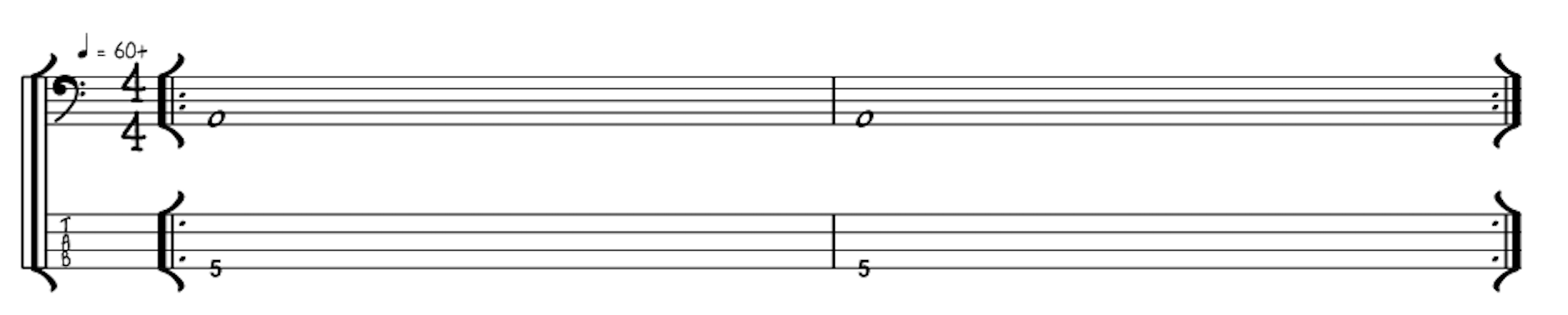
Listen as the note rings, keeping the timing steady.
Step 2: One Note Per Beat
Now play your A on every metronome click. These are quarter notes, also called crotchets.
Count:
1 2 3 4 1 2 3 4
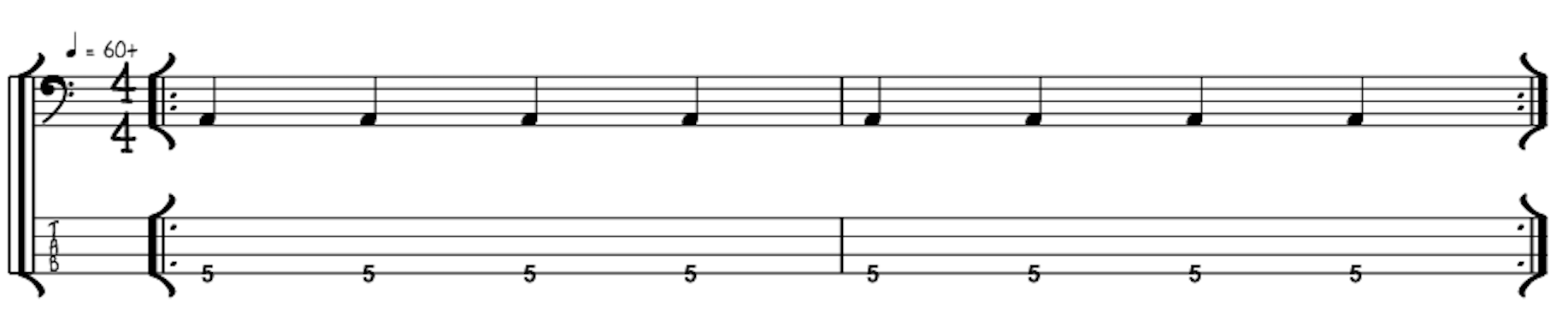
Are the notes evenly spaced and consistently clear?
Step 3: Two Notes Per Beat
Now play two evenly spaced notes per click.
Count:
1 + 2 + 3 + 4 +
The numbers fall on the clicks; the '+' (pronounced 'and') falls halfway between them. These are eighth notes (also 8th notes or quavers).
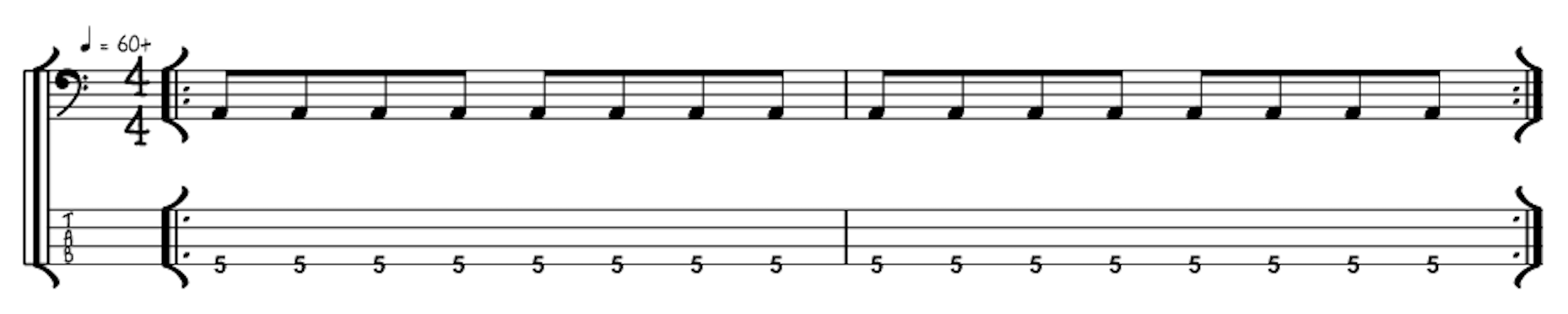
Alternate your index and middle fingers, keeping the plucking movement controlled. Pick players should also use small, relaxed movements.
Notice what's happening: You're now playing twice as many notes in the same amount of time, without increasing the metronome speed. This helps develop the coordination needed for faster playing while allowing you to concentrate on timing and consistency.
Step 4: Leave Some Space
Continue playing eighth notes, but leave out the note on beat two. Stop the previous note so there's a deliberate silence; keep counting, then play again on the 'and' after two.
Count:
1 + (2) + 3 + 4 +

This develops rhythmic accuracy and helps you maintain the underlying pulse, even when you're not playing.
Good timing isn't just about knowing when to play. It's also about knowing when not to play.
When Should You Increase The Tempo?
Once a pattern feels comfortable, check your timing, sound, and technique. Are the notes evenly spaced? Are your hands relaxed? If so, increase the tempo by around 4 bpm and listen again. If your timing becomes uneven or you begin to tense up, return to a comfortable tempo.
Remember, playing the same exercise more comfortably at yesterday's tempo is still progress.
Your 10-Minute Bass Challenge
Let's turn the exercise into a simple groove using two notes: A (fifth fret, E-string) and D (fifth fret, A-string). Play two bars on A, followed by two bars on D, repeating the four-bar pattern.
Minutes 1–3: Play one note per click at a comfortable tempo, changing between A and D every two bars.
Minutes 4–6: Play two notes per click, keeping the timing even as you change strings.
Minutes 7–8: Introduce the rhythmic gap on beat two of each bar, maintaining the pulse throughout.
Minutes 9–10: Return to the steady pattern. Try increasing the tempo slightly if everything feels controlled.
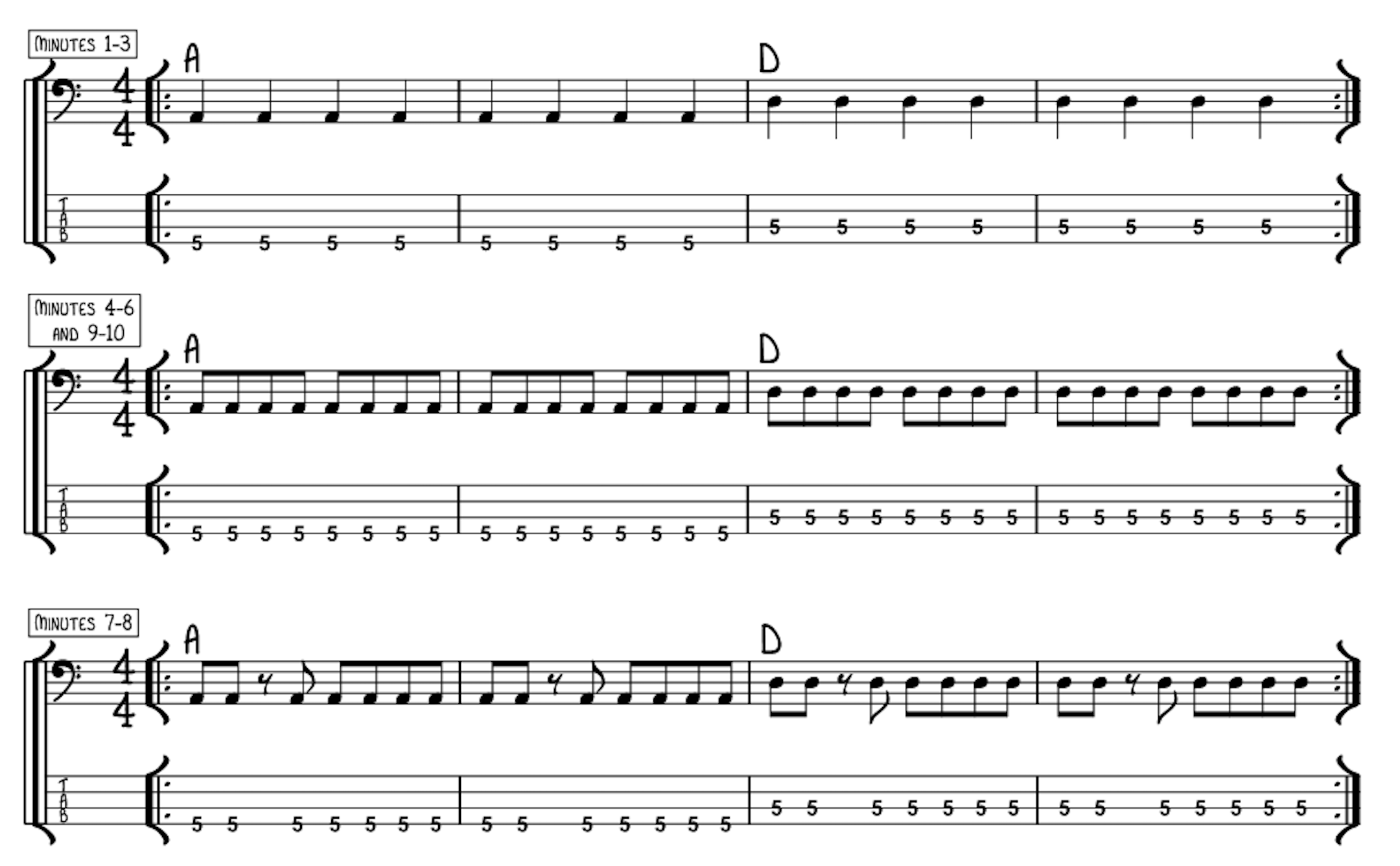
Notice how changing between just two notes makes the exercise feel more musical while introducing a little extra coordination. Make a note of your tempo and one thing you noticed. Perhaps your timing improved, your notes sounded clearer, or your hands felt more relaxed. That's something useful to build on next time.
Speed Comes From Control
Next time a bass line feels comfortable at a slow tempo but falls apart when you play along with the recording, don't immediately push yourself harder. Slow it down, listen carefully, and identify where you're losing control. Work on that problem first, then gradually increase the tempo. You'll often find that speed follows naturally when you give accuracy the attention it deserves.
I'd Love To Hear From You
When you try to play faster, what becomes difficult first? Does your timing drift, do notes become unclear, or do your hands start working harder?
Hit REPLY and tell me what happens when you increase the tempo.
Your experience could help shape a future edition of Bass Player's Weekly.
Keep grooving!
Andy Hodge
Bass Coach, eBassGuitar


About the Author – Andy Hodge
Andy Hodge is a professional bassist and eBassGuitar coach with over 40 years of experience performing, recording and teaching. One of the UK's most versatile bass players, Andy has worked with artists including Marc Almond, Chris Braide and Geoff Downes, and performed in West End productions such as We Will Rock You and Blood Brothers.
Andy brings a wealth of real-world musical knowledge to Bass Player's Weekly, sharing practical advice to help bass players of all levels improve their skills, build confidence and enjoy making music.
Andy's YouTube Pick This Week:
|

This week's lesson from James demonstrates exercises to develop plucking speed and accuracy on the bass.
Three ways we can help you become a better bass player:
1. Build your skills with our free weekly YouTube lessons→
2. Find a structured learning path with a 14-day free eBass+ trial →
3. Get personalised guidance through VIP coaching. →

Responses