 10-Week Applied Music Theory Accelerator · October 2026 Cohort
Discover The System That Turns Music Theory From A "Confusing Concept" Into Bass Lines You Can Play Along With Tunes You Love
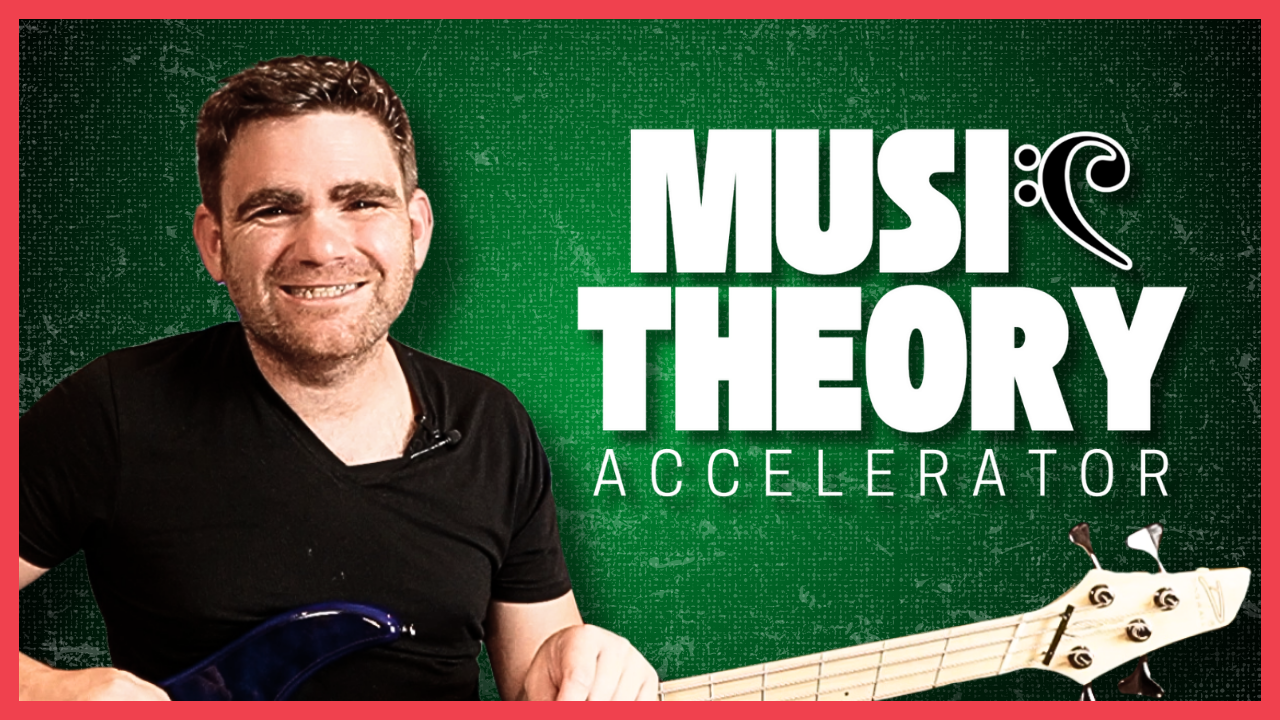
A 10-week live cohort that shows you the essential theory for bass and exactly how to apply it to songs, gigs, jams, or Sunday worship.
"It has been very helpful for connecting the music theory I learned many years ago with the actual playing of my bass guitar."
— Christopher T Kast
"Opened my eyes as to just how simple these things are when they are explained, then put into practice."
— Paul Vaughan
"I can figure out the structure of a song step by step and put the theory into practice."
— Thomas Thye
If learning music theory is all that it matters to become a better bass guitar player…
Then why is it that most bass players I talk with, even if they spend hours, weeks, even months learning theory…
Are still struggling to turn theory into bass lines…
Let alone use it to groove along their favorite tunes?
Maybe they know bits and pieces about scales, arpeggios, intervals.
Yet it still feels like an uphill battle to get it out on the fretboard.
Now, sometimes it goes the other way.
I've also worked with students who can already play really well.
Good tone, technique and great musicality.
Yet, they find it hard to articulate what they just played.
Yes, they're using the theory but only by instinct (which is fine by the way)
UNTIL you need to talk to the keyboard player or the guitarist about what's actually happening.
You see, after teaching thousands of students and playing on the road for over 20 years, here's what I've learned:
And that space in between? That's what I call the Theory Gap.
The Theory Gap is a frustrating place where you know bits about music theory but you're struggling to get them to flow into your bass lines, grooves, or songs.
And the reason so many bass players get stuck there is simple:
Sure, there's an abundance of resources you can learn theory from.
YouTube… books… courses… even AI can give you more knowledge than you'll ever need.
But here's what they never show you:
- ❌ They don't show you how to get it under your fingers.
- ❌ They don't show you how to make it live on your fretboard.
- ❌ They just toss you a concept, explain it a bit… then move on.
It's like college exams all over again.
You memorise a definition for the test then forget it the next week.
Because here's the thing:
Think about it…
You don't build stronger chest muscles by watching tutorials about push-ups.
You only build strength by actually doing them, over and over.
Music theory works exactly the same way.
You can memorise scales, write them neatly in a notebook, even binge hours of YouTube lessons…
But unless you put that knowledge onto the fretboard, it won't stick.

There's a classic psychology experiment that's been repeated for more than a century called the Ebbinghaus Forgetting Curve.
It shows that when we learn something new, whether it's a language, a skill, or a piece of music, our brains start to lose that information almost immediately.
In fact, research found that we can forget up to 70% of what we've learned within 24 hours if we don't actively review or apply it.
That's why you can watch a lesson on arpeggios or intervals, nod along thinking "got it," but by the next day, most of it has slipped away.
That's why athletes train with drills…
New languages are effectively learned through conversations..
The same is also true when it comes to music theory.
It only truly clicks when you put it to work on your bass guitar.
So the question becomes…
How do we actually apply music theory to the fretboard so it sticks in our mind, shows up under our fingers, and becomes part of the way we play?
How do we use it to build better bass lines, understand what we're really playing, and communicate it clearly with our bandmates…
Without spending months (or even years) stuck in theory books or endless exercises that never make it into the music?
That was the question we wanted to answer.
I'd been teaching music theory for years and had a pretty clear idea of what worked, but I also wanted a fresh perspective on how we could make those fundamentals connect more clearly.
That's where Sian Unwin, one of our eBassGuitar coaches, came in.
She brought a fresh take on how to organise and teach the material, and we worked through the ideas together from there.
When I first saw her take on it, I remember thinking:
"This is really, really good."
The concepts themselves weren't new.
But the way they connected was.
So we kept coming back to one question:
How do we make sure the player actually uses this?
And that led us to one simple principle:
Not just understood or memorised, but actually played.
From there, we started shaping a simple step-by-step process that could take almost any theory concept and move it through that journey every single time.
And that's where things really started to click…
The 4-Stage Applied Music Theory System
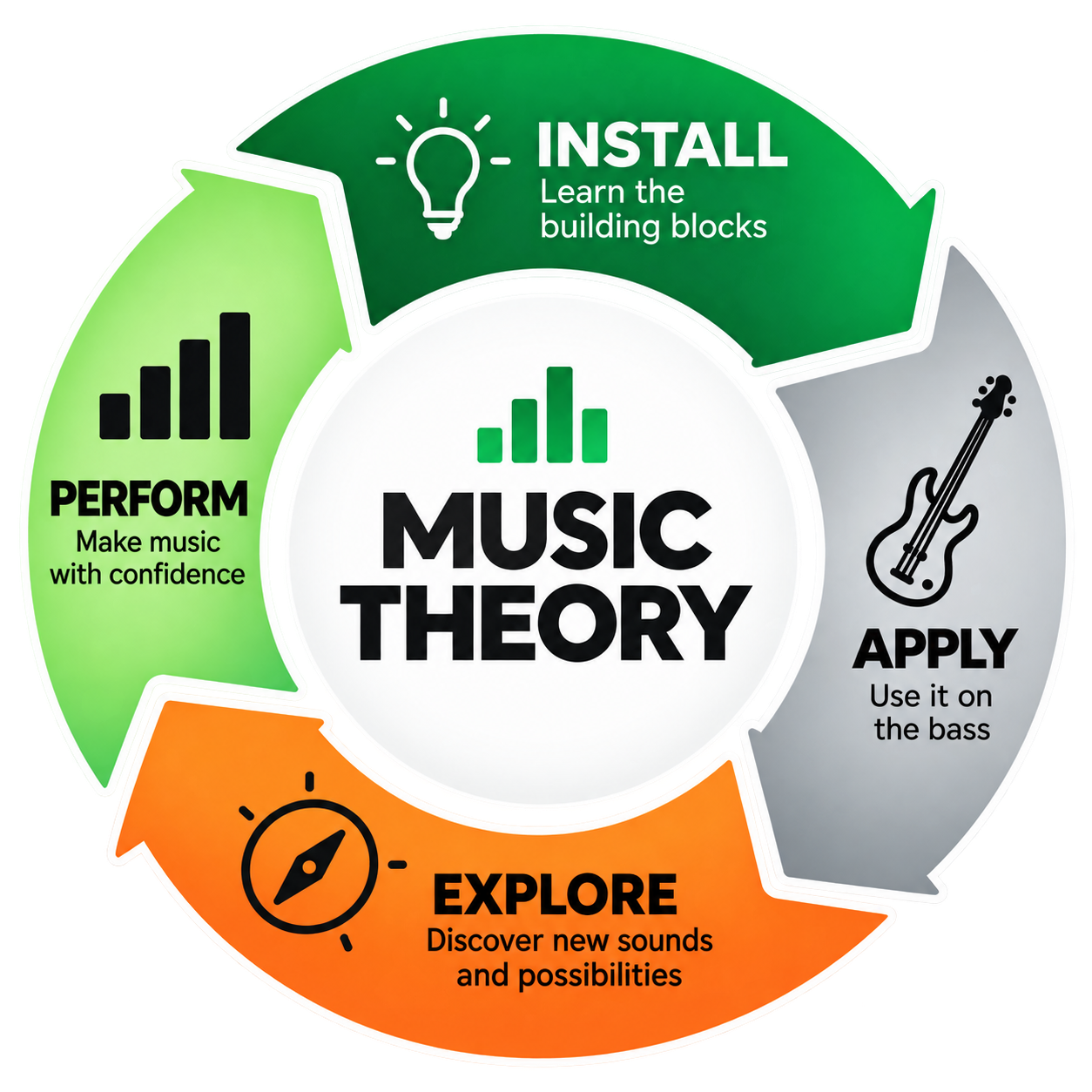
It's a complete re-wiring of how music theory is taught to bass players. At its core, this system builds on the same structure we've refined across thousands of eBassGuitar students, and it turns abstract theory into real-world playing.
Install
At this stage, you'll start with the core idea of a theory and strip it all back to what it really is and how it works.
The goal here is to NOT get buried in jargon but to understand how it applies to the fretboard.
This is where most books and videos stop — and why it all stays stuck in your head instead of showing up under your fingers.
Apply
Next, you'll start putting that idea into motion.
We'll use the same concept across different strings, shapes, and keys so your hands and ears begin to own it.
This is where theory starts to feel real, because you're not just dumping concepts in your head — you're putting it to work.
Explore
Now it's time to make it musical. This is where you'll explore the concept with riffs, fills, and rhythmic variations that bring the theory to life.
This is where you start to understand how rhythm, feel, and note choice connect, and how to express yourself through the line.
Perform
This is where it all comes together. You'll take everything you've built and throw it into a full song or backing track.
Just hit play and feel how your lines lock in with the groove, how your note choices lift the music, and how confidently you play because you understand what's happening.
That's when theory stops being theory… and becomes music.
And that's it.
Simple but powerful steps, isn't it?
It closes the gap between knowing and doing.
Once you've learned to move through these four stages, you can use the same process every time you study something new — whether it's intervals, scales, chords, rhythm, or harmony.
- You install it.
- You apply it.
- You explore it.
- You perform it.
That's how you turn theory into something you can actually use on the bass guitar.
This system isn't about memorizing theory that collects dust in your head.
It trains your hands and ears to feel how theory lives on the instrument.
That's why it works.
It rewires how you think, hear, and play until theory becomes second nature.
Now you can take this and run with it…
Or you can see exactly how we've built an entire learning experience around it…
The same framework that's already helped hundreds of our students transform their playing.
The 10-Week Applied Music Theory Accelerator
It's the ONLY program that takes you through the 4-Stage Applied Music Theory System step by step. It will show you just the essential music theory you need as a bass player and how to apply it on the fretboard so you can play even better bass lines — all in 10 weeks.
10-Week Lesson
Follow the system across 5 modules, each built around songs, so you can apply theory directly to your playing as you go.
3 Levels Of Learning
Each concept includes easy, intermediate, and advanced drills so you can choose the level that fits your playing right now.
Learn With A Cohort
Progress alongside a community of bassists on the same journey. Join bi-weekly live sessions, share wins, stay inspired, and grow together.
Personalized Feedback
Record short performances at the end of each module and get personalised feedback to stay accountable and keep improving.
Learning Tools
Access a variety of resources like workbooks, tabs, PDFs, backing tracks, and more to help you learn efficiently.
Lifetime Access
Revisit lessons and coaching replays anytime to refresh your skills.
What It Looks Like In The Next 10 Weeks
Weeks 1–2 Major Triads & Fretboard Connection (Setting The Foundations)"In the Midnight Hour" — Wilson Pickett ⌄
We'll kick off by mapping the fretboard through major scales and triads so you can see, hear, and play how chords I–IV–V connect across the neck, using "In the Midnight Hour" by Wilson Pickett to bring the theory to life.
Whilst simple on the outset, even a seasoned player will find something new to explore and be pushed musically and technically to think differently.
You'll Learn
- Map the E major scale in three positions (home, forward, and open) so you can move confidently anywhere on the neck.
- Build major triads (I–IV–V) from your scale and turn them into bass lines that outline the harmony clearly.
- Turn scales and triads into solid, musical bass lines you can use in rehearsals, jams, and gigs.
- Adapt each shape for 4- and 5-string basses so you can flow smoothly across registers.
Weeks 3–4 Minor Triads & Expressive Playing"Abracadabra" — Steve Miller Band ⌄
Next, we'll dive into the mysterious world of minor harmony using "Abracadabra" by Steve Miller Band to explore how minor keys change the emotion and colour of your bass lines.
Many students are confused by minor harmony and how to apply it — this module will lift the curtain on its application so it falls naturally under the hand.
You'll Learn
- Play the A minor scale in home, reverse, and open positions to expand your comfort zone.
- Construct minor triads (i–iv–v) and hear how just one note (the 3rd) changes the whole mood.
- Add dominant and 7th chords to create stronger resolutions and a blues-infused tone.
- Turn minor-key shapes into smooth, expressive bass lines that fit real songs.
Weeks 5–6 Connecting Chords With The Linear Method"Brown Eyed Girl" — Van Morrison ⌄
This module is all about creating flow. We'll use "Brown Eyed Girl" by Van Morrison to learn voice leading — connecting chords with stepwise, melodic movement that makes your lines sound musical and intentional.
This will help you create melodic bass lines inspired by players such as Paul McCartney and even Johann Sebastian Bach!
You'll Learn
- Link chords using approach notes and linear scale movement to make transitions seamless.
- Combine upper and lower approaches to balance tension and release in your bass lines.
- Turn approach-note concepts into melodic bass lines that sing over I–IV–V–vi progressions.
- Refine your phrasing so your lines feel like part of the song, not just root notes.
Weeks 7–8 Groove, Rhythm & Feel"Walking on the Moon" — The Police / "Rosanna" — Toto ⌄
This module focuses on rhythmic precision, turning theory into feel. You'll learn to move between straight and shuffle time using "Walking on the Moon" by The Police and "Rosanna" by Toto as your training grounds.
Many students feel rhythm is a weakness in their playing, and this module will give you the crucial information on how to find the pocket and apply rhythmic concepts musically — introducing you to the rhythmic worlds of funk and reggae.
You'll Learn
- Differentiate between straight and shuffle feels so your grooves fit any band or drummer.
- Lock with the kick and snare by controlling note length, rests, and dynamic placement.
- Transform the same bass line between straight and shuffle feels to master rhythmic versatility.
- Turn syncopation and triplet motion into grooves that bounce and breathe.
Weeks 9–10 Integration: Blues & Real-World Performance"Life in the Fast Lane" — Eagles ⌄
It's time to bring everything together. You'll combine theory, rhythm, and stylistic flair in a 12-bar blues using "Life in the Fast Lane" by The Eagles to see how everything connects in the real world.
This is the chance to put one final epic performance together, featuring all of the skills you've learned along the way.
You'll Learn
- Combine R–3–5 triads, pentatonic linear movement, and approach notes into complete blues lines.
- Techniques to create fills that "pop" across the whole fretboard.
- Apply the I–IV–V flow across keys and add turnarounds for authentic blues phrasing.
- Blend straight and shuffle feels to develop a true groove player's sense of pocket.
- Turn all your theory knowledge into a confident, song-ready performance.
Why This Cohort Fits So Nicely Into The Rest Of Your Year
The October cohort starts on October 5 and runs for ten weeks, which means we'll finish in the second week of December.
So before Christmas arrives and the year winds down, you'll have worked through the full programme and spent ten focused weeks turning theory into something you can actually use on the bass.
By the end, you should have a clearer understanding of how harmony, chord movement, rhythm and groove connect, along with a practical process you can keep using every time you learn something new.
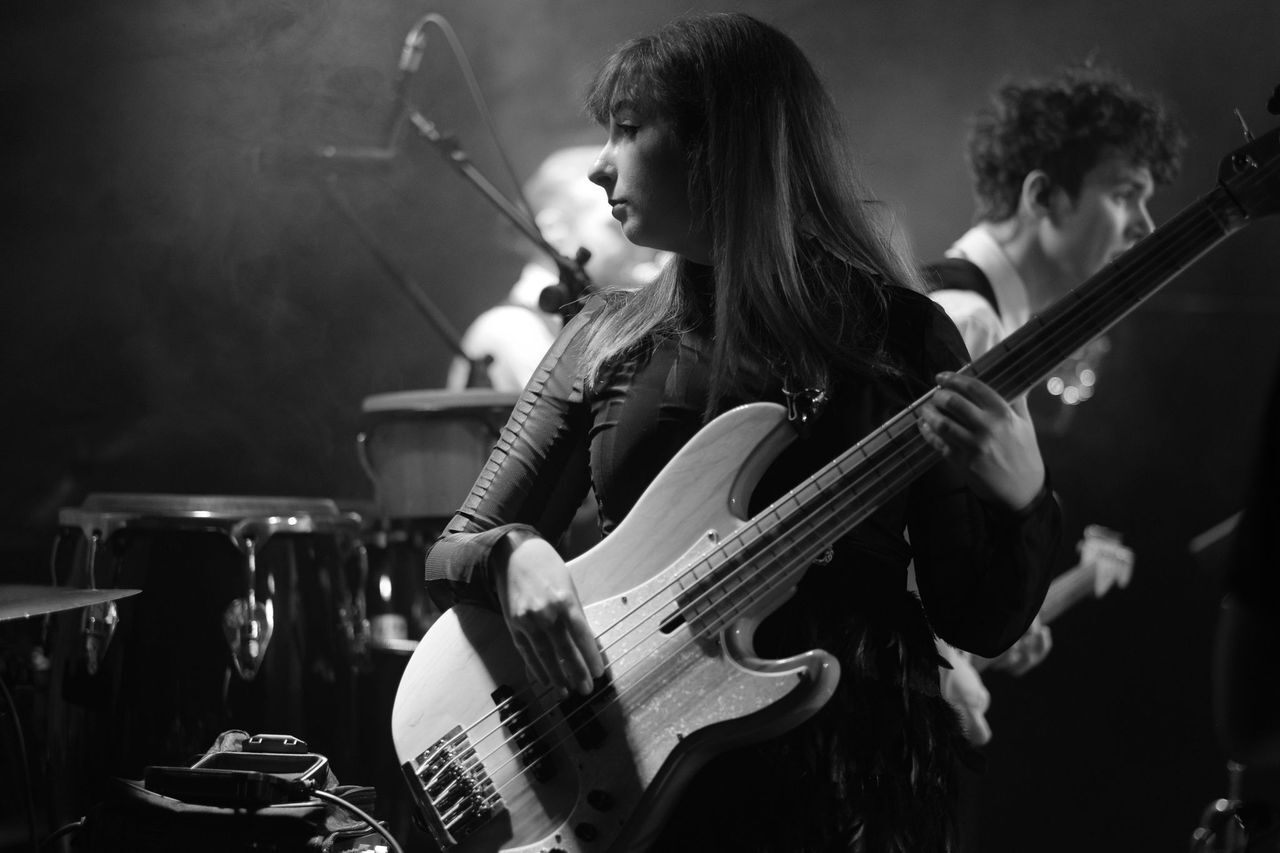
Sian Unwin
Curriculum Writer & Lead Coach
Sian is one of our eBassGuitar coaches and a professional bass guitarist with years of real-world playing and teaching experience.
She graduated with top honours and won the Peter Evans Prize for the highest performance grade at her university. She's also performed with The Faithettes, at Glastonbury Festival, and alongside musicians who've toured with artists including Sam Smith, Dua Lipa, Sam Ryder and Alexandra Burke.
She wrote and structured the 10-week curriculum for the Applied Music Theory Accelerator, using the same tried-and-tested eBassGuitar challenge structure we've refined across thousands of students.
James then brings that curriculum to life in the core video lessons, guiding you through each concept step by step, while Sian supports the learning journey through the programme and coaching.
Inside the Accelerator, you'll get the benefit of Sian's carefully structured curriculum, James' teaching on video, and the wider eBassGuitar coaching approach that helps you move from understanding theory to actually using it on the fretboard.
Find Your Spot In The October 2026 Cohort
Early Bird Pricing
We opened this cohort at $149 to reward those who were ready to commit early and to help us plan the coaching, feedback and support around the cohort before it began.
$249 is now the price for the rest of the October 2026 cohort.
So if you're ready to join us, this is the price for the rest of the October 2026 cohort — there's no further increase to plan around.
Cohort
Pay In Full
Or 2 × $130 — $260 total
- 10-Week Applied Music Theory Accelerator core lessons to master essential bass theory step by step
- PDF workbooks, tabs & notation sheets to guide your practice in every module
- High-quality backing tracks to play along with full-band arrangements and lock in your groove
- Lifetime access so you can revisit lessons and refresh your skills anytime
- 5 total bi-weekly live group coaching sessions to get direct guidance, feedback, and accountability
- Group coaching session replays so you can review and catch up anytime
- Private student community to connect, share progress, and stay motivated with fellow learners
- Up to 5 video submission opportunities every two weeks to showcase your progress
- Up to 5 personalised feedback sessions from the eBassGuitar coaching team on your submitted videos
- Bonus: The Complete Guide To Music Theory For Bass Players book (digital edition)
Backed by a 30-day money-back guarantee

30 DAY MONEY-BACK GUARANTEE
I want you to be 100% confident when you join The 10-Week Applied Music Theory Accelerator.
So here's my simple promise: Try the program for 30 days from when it officially begins on October 5, 2026.
Go through the lessons, join the coaching sessions, and put the system into practice.
If you don't feel a clear difference in how you understand and use theory on your bass lines, just drop us an email at support@ebassguitar.com and we'll give you a full refund.
That's how confident I am that this system works. Because once you start hearing how theory connects to your bass… you'll never want to go back to guessing again.
Cohort Officially Starts On October 5, 2026 And Doors Will Close Just Before Then.
Once they do, that's it.
You'll have to wait until next year for the next intake.
So this is the moment to decide which road you want to take.
You can keep dipping in and out of random YouTube videos, collecting bits of theory, hoping it'll somehow click on its own.
But if we're being honest, that's probably what's kept you spinning your wheels so far.
Another six months of that, and you'll still be guessing when the band changes key or defaulting to the same old root notes.
Or… you can take a different route.
You can join us and a group of bass players just like you inside The 10-Week Applied Music Theory Accelerator.
You'll get access to a system that takes you from understanding theory to actually using it inside real songs.
You'll have live coaching, feedback, and a community to keep you accountable every step of the way.
And by the time we wrap up in the second week of December, you'll have spent ten focused weeks putting all of this into practice.
You'll have worked through major and minor harmony, chord movement, rhythm, groove and real-world bass lines, with a much clearer understanding of how those pieces fit together every time you pick up the bass.
Then you can head into Christmas, and into 2027, with a practical way to keep building on everything you've learned.
The choice is simple…
Keep guessing, keep freezing, keep hoping it'll click someday…
Or fix it for good, starting October 5, 2026.
Your choice.